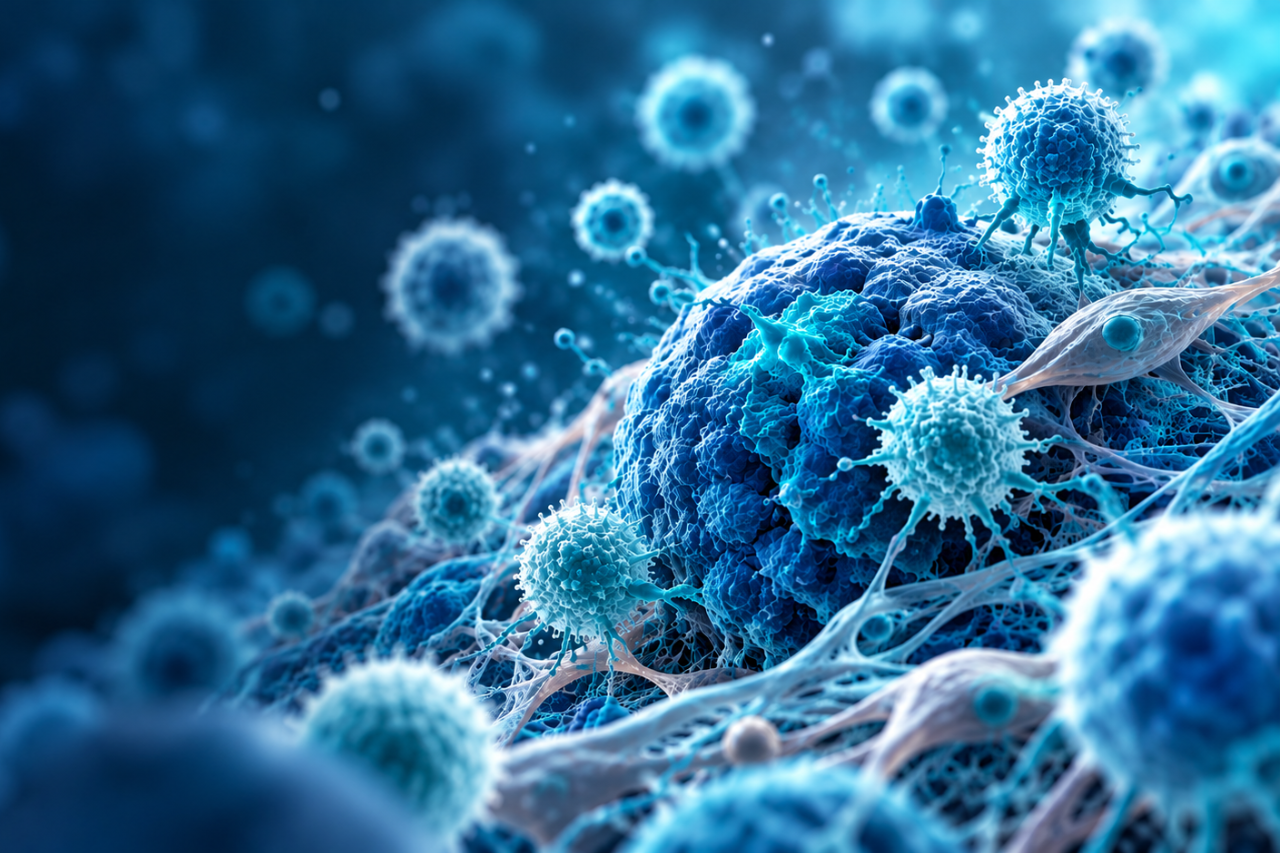
For decades, cancer drug development focused primarily on the tumor cell. Researchers identified oncogenic mutations, developed targeted therapies, and sought increasingly effective ways to destroy malignant cells.
These advances transformed oncology. But they also revealed an important limitation: a therapy can successfully engage its intended target and still fail if the environment surrounding the tumor prevents an effective response.
This realization has elevated the tumor microenvironment (TME) from a largely descriptive biological concept to an increasingly important therapeutic focus. Today, researchers recognize that treatment response depends not only on the molecular characteristics of the cancer itself, but also on the complex biological ecosystem in which it exists.[1]
Beyond “Hot” and “Cold” Tumors
Tumors are often described as immunologically “hot” or “cold”. Hot tumors generally contain greater immune-cell infiltration and may be more responsive to immunotherapy. Cold tumors, by contrast, may contain few tumor-infiltrating lymphocytes or create conditions that prevent those cells from functioning effectively.
But these labels describe the state of a tumor, rather than the biological processes that created it. These processes are shaped by the tumor microenvironment, a complex network of immune cells, cancer-associated fibroblasts (CAFs), blood and lymphatic vessels, extracellular matrix (ECM), cytokines, metabolites, and signaling molecules surrounding the cancer.
These components constantly interact with tumor cells and with one another, influencing tumor growth, metastasis, immune evasion, and response to treatment.
This has led to a different therapeutic question:
Instead of targeting only the tumor cells, can we also change the environment that helps it survive?
This question has fundamentally changed how oncology approaches therapy development.[1][2]
How the Tumor Microenvironment Shapes Treatment Response
The TME does far more than provide structural support for a tumor. It is a dynamic biological system that changes as disease progresses and in response to treatment pressure.
One of its most important features is immune suppression. Tumors can recruit regulatory T cells (Tregs), myeloid-derived suppressor cells (MDSCs), and tumor-associated macrophages that inhibit cytotoxic immune responses. Even when immune cells recognize malignant cells, the surrounding environment may prevent them from mounting an effective anti-tumor response.[1]
The TME can also create physical barriers. Dense extracellular matrix, activated fibroblasts, and abnormal tumor vasculature can restrict immune-cell infiltration and reduce drug penetration into the tumor tissue.
Metabolism adds another layer of complexity. Rapid tumor growth, abnormal vasculature, and altered cellular metabolism can create regions characterized by hypoxia, nutrient depletion, and extracellular acidity. These conditions can support tumor survival while compromising immune-cell activity and contributing to treatment resistance.[3][4]
The result is a protective ecosystem in which tumor cells are influenced not only by their own molecular characteristics, but also by the biological conditions surrounding them.
Metabolism as a Therapeutic Target
Among the metabolic features of the TME, extracellular acidity is attracting increasing therapeutic interest. Cancer cells frequently rely heavily on glucose metabolism and can generate substantial quantities of acidic metabolic products. Combined with poor tumor perfusion and inadequate clearance, this can lower extracellular pH within the TME.
An acidic TME can affect multiple aspects of tumor biology. It may impair the activity of effector immune cells, favor immunosuppressive cell populations, and contribute to conditions that support tumor invasion and therapeutic resistance.[3][4]
Acidity is therefore one example of how a feature of the TME may move from being viewed simply as a consequence of tumor biology to a potentially modifiable therapeutic target.
Strategies to Reshape the Tumor Ecosystem
As researchers increasingly ask how we can make the surrounding environment less capable of protecting tumors, a growing number of approaches are being explored to modify the TME alongside established and novel anticancer therapies.
One major strategy focuses on modulating immune suppression. Researchers are developing therapies that reprogram tumor-associated macrophages, inhibit suppressive cytokines such as TGF-β, and target additional immune checkpoints beyond PD-1 and CTLA-4, including TIGIT, TIM-3, LAG-3, and VISTA. Rather than directly attacking cancer cells, these approaches aim to remove the biological barriers preventing effective immune responses.[4-6]
Another area of innovation involves improving immune-cell infiltration. Dense stroma, abnormal vasculature, and fibrotic extracellular matrix often prevent immune cells from reaching the tumor core. Anti-angiogenic therapies, radiation, chemotherapy, and targeted agents are increasingly being combined to improve T-cell recruitment and convert immune-excluded tumors into immune-active ones.[4][5][6]
Researchers are also working to remodel the extracellular matrix itself. Cancer-associated fibroblasts and ECM proteins such as collagen contribute to tissue stiffening and poor drug penetration. Therapies that reduce stromal density or modify matrix composition may improve both drug delivery and immune-cell access, making existing treatments more effective.
Tumor metabolism has become another important target. By disrupting pathways involved in hypoxia, glucose utilization, lactate production, and acidosis, researchers aim to reverse the metabolic conditions that promote immune dysfunction and therapeutic resistance.
Finally, a number of modern treatment strategies seek to increase responsiveness to immunotherapy through rational combinations. Pairing checkpoint inhibitors with TME-modulating therapies aims to convert “cold” tumors into “hot” tumors in order to allow a larger proportion of patients to benefit from immune-based treatments.[4-6]
Precision Oncology Is Expanding Beyond Genomics
The growing importance of the TME is also changing the concept of precision oncology. Traditionally, precision medicine has focused heavily on identifying genetic alterations and matching patients with therapies directed against those molecular targets. This remains fundamental to modern cancer treatment.
But genomics alone cannot explain every difference in treatment response. Two tumors carrying similar driver alterations may exist within very different immune, metabolic, vascular, and stromal environments. These differences may influence whether immune cells reach the tumor, whether drugs penetrate it, and whether the biological conditions surrounding the cancer support or suppress treatment activity.
The next generation of precision oncology is therefore becoming increasingly multidimensional, incorporating not only tumor genetics, but also immune composition, spatial biology, vascular function, extracellular matrix organization, and metabolic state.[7]
Changing the Conditions in Which Cancer Survives
The evolution of the tumor microenvironment from biological observation to therapeutic target represents an important shift in cancer research.
Rather than viewing cancer solely as a collection of malignant cells, researchers increasingly recognize it as a complex and adaptive ecosystem — a perspective that creates new therapeutic possibilities.
Future advances may come not only from discovering new tumor-specific targets, but also from changing the conditions that determine whether therapies can reach those targets, whether immune cells can function effectively, and whether the tumor can continue to protect itself.
At Helix BioPharma, this biology is central to how we think about oncology. Our research includes approaches designed to address features of the tumor microenvironment, including extracellular acidosis, with the goal of creating conditions that may better support antitumor activity and complement existing therapeutic approaches. Because treating cancer may ultimately require more than targeting the malignant cell itself; it may also require changing the environment that allows it to survive.
References:
1. Xiao Y, Yu D. Tumor microenvironment as a therapeutic target in cancer. Pharmacol Ther. 2021 May;221:107753. doi: 10.1016/j.pharmthera.2020.107753. Epub 2020 Nov 28. PMID: 33259885; PMCID: PMC8084948.
2. de Visser KE, Joyce JA. The evolving tumor microenvironment: From cancer initiation to metastatic outgrowth. Cancer Cell. 2023 Mar 13;41(3):374-403. doi: 10.1016/j.ccell.2023.02.016. PMID: 36917948.
3. Roma-Rodrigues C, Mendes R, Baptista PV, Fernandes AR. Targeting Tumor Microenvironment for Cancer Therapy. Int J Mol Sci. 2019;20(4):840. Published 2019 Feb 15. doi:10.3390/ijms20040840
4. Bejarano L, Jordāo MJC, Joyce JA. Therapeutic Targeting of the Tumor Microenvironment. Cancer Discov. 2021 Apr;11(4):933-959. doi: 10.1158/2159-8290.CD-20-1808. PMID: 33811125.
5. Babar Q, Saeed A, Tabish TA, Sarwar M, Thorat ND. Targeting the tumor microenvironment: Potential strategy for cancer therapeutics. Biochim Biophys Acta Mol Basis Dis. 2023 Aug;1869(6):166746. doi: 10.1016/j.bbadis.2023.166746. Epub 2023 May 7. PMID: 37160171.
6. Tufail M. Unlocking the potential of the tumor microenvironment for cancer therapy. Pathol Res Pract. 2023 Nov;251:154846. doi: 10.1016/j.prp.2023.154846. Epub 2023 Oct 4. PMID: 37837860.
7. Sabit H, Pawlik TM, Radwan F, Abdel-Hakeem M, Abdel-Ghany S, Wadan AS, Elzawahri M, El-Hashash A, Arneth B. Precision nanomedicine: navigating the tumor microenvironment for enhanced cancer immunotherapy and targeted drug delivery. Mol Cancer. 2025 Jun 3;24(1):160. doi: 10.1186/s12943-025-02357-z. PMID: 40457437; PMCID: PMC12131435.