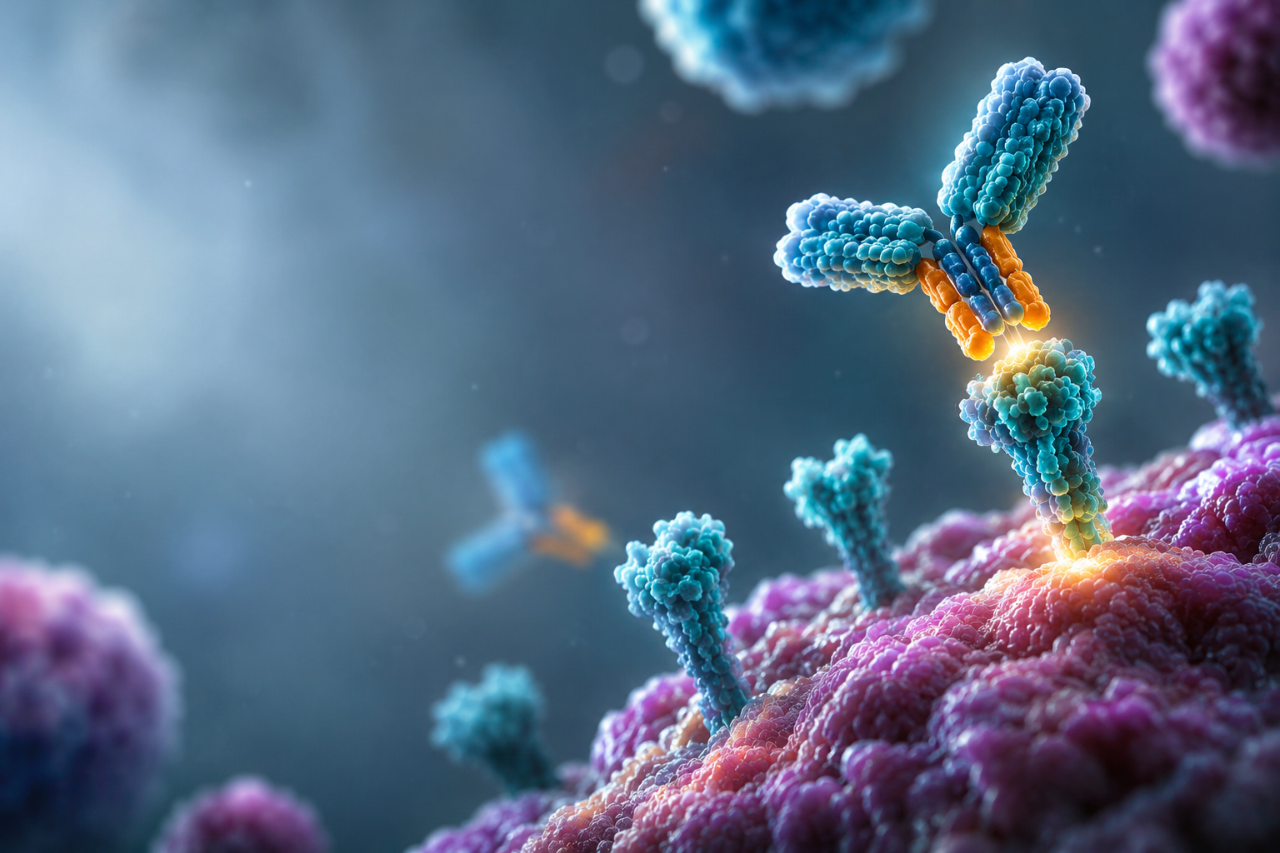
Carcinoembryonic antigen-related cell adhesion molecule 6 (CEACAM6) is a glycoprotein tethered to the outer surface of the cell membrane through a glycosylphosphatidylinositol (GPI) anchor. In healthy tissues, it is expressed on certain epithelial surfaces and myeloid cells, including granulocytes. In cancer, CEACAM6 is frequently overexpressed, particularly in pancreatic, lung, breast, colorectal, gastric, and hepatocellular tumors.[1,2]
Three characteristics make CEACAM6 an attractive therapeutic target:
First, it is surface-accessible. As a cell-surface protein, CEACAM6 can be recognized and bound by antibodies, making it a suitable target for a range of antibody-based therapeutic approaches.
Second, it is frequently overexpressed in solid tumors. In one study, robust CEACAM6 expression was detected in more than 90% of invasive pancreatic adenocarcinomas, as well as in precancerous pancreatic lesions.[3] In non-small cell lung cancer (NSCLC), CEACAM6 expression was detected in 71% of tumor specimens in one immunohistochemical study, although prevalence varied by histological subtype. A separate analysis identified high CEACAM6 expression in 45.2% of 31 NSCLC tumor samples.[4] In colorectal cancer, CEACAM6 was upregulated in approximately 80% of tumor samples in one study, with elevated expression also associated with increased invasiveness and poorer survival outcomes.
Third, it is associated with aggressive disease biology. CEACAM6 has been linked to resistance to apoptosis (programmed cell death), treatment resistance, invasion, and metastasis. Its overexpression has also been associated with poorer survival outcomes across several cancer types.[1] For example, observational studies have reported shorter median overall survival in patients with elevated serum CEACAM6 levels in pancreatic cancer (12.6 versus 17.0 months) and high tumor CEACAM6 expression in gastric cancer (17 versus 43 months).[2]
CEACAM6 may also contribute to tumor immune evasion. Preclinical research has shown that CEACAM6 expressed on cancer cells can interact with CEACAM1 on activated T cells, suppressing their antitumor activity. This interaction appears to operate independently of the PD-1/PD-L1 pathway targeted by established immune checkpoint inhibitors. Since many patients do not respond to these therapies or eventually develop resistance, these findings provide a rationale for investigating CEACAM6 blockade as a potentially complementary immunotherapy strategy.[5]
Together, these findings highlight CEACAM6 as a compelling target for therapeutic development across solid tumors. Its cell-surface accessibility, association with aggressive disease, and emerging role in immune regulation offer several avenues for therapeutic intervention. The opportunity now lies in translating this biological rationale into clinical benefit through innovative therapeutic approaches and appropriate patient selection.
Lessons learned from the wider ADC landscape
The development of antibody-drug conjugates (ADCs) provides perspective on the opportunities and challenges of targeting cell-surface proteins in oncology.
Therapies directed against HER2, TROP2, Nectin-4, and folate receptor alpha (FRα) have demonstrated that combining a suitable target with an effective payload and appropriate patient selection can translate into clinical benefit. Trastuzumab deruxtecan, for example, has extended HER2-targeted treatments to patients with lower levels of HER2 expression, while other approved ADCs have established new treatment options in breast, urothelial, and ovarian cancers.
However, success in one cancer type does not necessarily translate into success in another, even when targeting the same protein. Sacituzumab govitecan, a TROP2-directed ADC approved for certain breast cancers, did not meet its primary endpoint of improving overall survival in the Phase III EVOKE-01 trial in previously treated metastatic NSCLC.
These experiences highlight an important distinction: identifying a biologically relevant target is only the starting point. Clinical outcomes also depend on the therapeutic mechanism, normal-tissue expression, drug delivery, tolerability, and selection of patients whose tumors are most likely to respond.
This is particularly relevant to CEACAM6, where emerging therapeutic approaches are seeking to exploit different aspects of the target’s biology.
CEACAM6-specific approaches
One such approach is our lead candidate, L-DOS47. Unlike conventional ADCs, which use cell-surface targets to deliver cytotoxic payloads, L-DOS47 uses CEACAM6 to direct an enzyme toward tumors, with the aim of modifying their acidic microenvironment.[4] Extracellular acidity is a characteristic feature of solid tumors and is increasingly recognized as a contributor to immune suppression and treatment resistance.
L-DOS47 combines the CEACAM6-targeting single-domain antibody AFAIKL2 (nanobody) with urease, an enzyme that breaks down naturally occurring urea, generating ammonia that can raise extracellular pH. Preclinical tissue studies have demonstrated preferential binding of the nanobody’s precursor to lung adenocarcinoma tissue compared with normal lung tissue, supporting its tumor-targeting potential.[4] By directing urease activity toward CEACAM6-expressing tumors, L-DOS47 is being developed to counter tumor acidity and enhance the activity of other anticancer therapies.[4,6]
L-DOS47 was initially developed as a monotherapy and evaluated in a Phase I/II clinical study involving 76 patients with advanced NSCLC. The study established a favorable safety and tolerability profile, with doses of to 13.55 μg/kg evaluated without reaching the maximum tolerated dose. Although no objective tumor responses were observed, post hoc exploratory analyses identified encouraging signs of activity at higher doses. Median progression-free survival reached 4.1 months in the highest-dose quartile, compared with 1.2 to 3.0 months across the three lower-dose quartiles, despite 93% of patients in the highest-dose group having received at least two prior lines of treatment.[4]
This early study provided important insights that helped shape L-DOS47’s subsequent development. In Phase II, dosing frequency was increased to address the drug’s relatively short apparent half-life, but no objective responses were observed. Importantly, patients had not been selected based on tumor CEACAM6 expression, raising the possibility that some lacked sufficient target expression for L-DOS47 to exert its intended effect. Although this could not be confirmed retrospectively, the experience helped inform the program’s evolution toward combination therapy and highlighted the potential importance of biomarker-based patient selection in future studies.
The combination strategy was explored in a Phase I study evaluating L-DOS47 alongside pemetrexed and carboplatin in patients with advanced nonsquamous NSCLC. Treatment was generally well tolerated, with no dose-limiting toxicities observed among the 14 patients enrolled. Of the 12 patients evaluable for efficacy, five (41.7%) achieved partial responses, including one particularly pronounced response involving a 91% reduction in target-lesion size. Four additional patients achieved stable disease, bringing the clinical benefit rate to 75%, while the median duration of response was 187 days.[6]
Although this small, uncontrolled Phase I study was not designed to establish the contribution of L-DOS47 to the observed responses, the findings provided encouraging preliminary evidence of antitumor activity with the combination and supported further investigation of L-DOS47 alongside established anticancer therapies.
Building on these findings, we investigated whether L-DOS47 could enhance the effectiveness of immunotherapy by countering tumor acidity. In collaboration with researchers at Moffitt Cancer Center, we explored this approach in pancreatic ductal adenocarcinoma (PDAC), a cancer in which CEACAM6 is frequently overexpressed and show highly immunosuppressive tumor microenvironment has contributed to limited responses to immune checkpoint inhibitors.
In a preclinical mouse model of PDAC engineered to express human CEACAM6, L-DOS47 increased extracellular tumor pH, confirming its ability to modify the acidic tumor microenvironment. Importantly, combining L-DOS47 with an anti-PD-1 therapy significantly reduced tumor growth compared with anti-PD-1 treatment alone over four weeks. Representative endpoint measurements showed an approximately 70% lower tumor volume (129 versus 424 mm³), while mean tumor weight was approximately 50% lower in the combination group. These findings suggest a potentially synergistic effect, whereby reducing tumor acidity may alleviate local immune suppression and enable stronger antitumor response to PD-1 blockade.[7]
Building on L-DOS47’s clinical safety experience in NSCLC and the preclinical evidence supporting its combination with immunotherapy, Helix is preparing LDOS007, a Phase Ib/randomized Phase II study evaluating L-DOS47 alongside pembrolizumab in first-line advanced nonsquamous NSCLC. Unlike earlier studies, LDOS007 will require qualifying tumor CEACAM6 expression and will evaluate whether adding L-DOS47 improves outcomes compared to pembrolizumab alone.
Whereas L-DOS47 uses CEACAM6 to target tumor acidity, other therapeutic approaches have focused on the protein’s potential role in immune suppression.
One example is tinurilimab (BAY 1834942, Bayer), a humanized monoclonal antibody designed to block the interaction between CEACAM6 on tumor cells and CEACAM1 on T cells, with the aim of restoring antitumor immune activity. In a first-in-human Phase I study involving 30 patients with advanced solid tumors, investigators explored the safety and preliminary activity of this approach. Although no objective responses were observed, the study provided early clinical insights into CEACAM6 blockade, including safety challenges associated with neutropenia and cytokine release syndrome. Development was ultimately discontinued following an unfavorable benefit–risk assessment.[5]
84-EBET (Eisai) explores another promising approach to CEACAM6 targeting through an ADC designed to deliver a bromodomain and extra-terminal (BET) protein degrader to cancer cells. BET proteins help regulate the expression of genes involved in cancer cell growth and survival, making their degradation a promising strategy for disrupting tumor progression. The antibody was selected for minimal reactivity with normal CEACAM6-expressing cells, with the aim of improving tumor selectivity.
In patient-derived pancreatic cancer models, a single dose induced substantial tumor regression, while bystander effects extended to CEACAM6-negative tumor cells and modulated inflammatory activity in cancer-associated fibroblasts. Combining 84-EBET with standard chemotherapy or anti-PD-1 therapy produced deeper and more sustained tumor regression in preclinical models, supporting further investigation of this approach.[8]
An early anti-CEACAM6 ADC developed by researchers at Genentech combined a CEACAM6-targeting antibody with a maytansinoid payload, a cytotoxic agent that disrupts cell division. In preclinical pancreatic cancer models, the ADC demonstrated antitumor activity against established CEACAM6-expressing tumors, providing early evidence of the target’s potential for drug delivery. Studies in nonhuman primates also identified dose-dependent but reversible depletion of granulocytes and their precursors, highlighting the importance of normal-tissue expression and the need to optimize the therapeutic window of CEACAM6-directed ADCs.[3]
Broader CEACAM-family approaches
Beyond approaches directed specifically at CEACAM6, researchers are also exploring therapeutic strategies that target molecular features shared with other members of the CEACAM family. Some focus on tumor-associated glycosylation patterns, which may help distinguish cancer-associated forms of CEACAM5 and CEACAM6 from those found in healthy tissues. These strategies offer additional opportunities for targeted therapy, with early clinical studies beginning to provide insights into their therapeutic potential and safety profiles.
EBC-129 (Experimental Drug Development Centre, Singapore) takes a different approach to tumor selectivity by targeting a specific tumor-associated glycosylation pattern at the N256 site shared by CEACAM6 and CEACAM5. This allows the ADC to recognize a molecular feature associated with cancer cells and deliver a cytotoxic payload. In an initial Phase Ia dose-escalation study involving 18 patients with advanced solid tumors, three partial responses were observed, including two in esophageal adenocarcinoma and one in PDAC. Although Grade 3 or higher decreases in neutrophil counts were reported in 55% of patients, the early evidence of antitumor activity supported further clinical investigation of this approach.[9]
Subsequent Phase I data have provided further encouraging evidence of preliminary antitumor activity. Among 21 heavily pretreated patients with PDAC selected for target-antigen expression, the reported overall response rate was 19.0%, although responses remained unconfirmed. In a separate cohort patients with gastroesophageal adenocarcinoma, five of 17 evaluable patients achieved responses (29.4%, including one unconfirmed response), with higher response rates observed in tumors expressing greater levels of the target antigen. While these early findings require confirmation in larger studies, and clinically significant neutropenia continues to be an important safety consideration, they support continued investigation of EBC-129 across difficult-to-treat solid tumors. In May 2025, EBC-129 received FDA Fast Track designation for PDAC in May 2025.[9]
NEO-201 (Precision Biologics) is a humanized monoclonal antibody that recognizes tumor-associated glycosylated forms of CEACAM6 and CEACAM5 through core 1 O-glycan structures. Beyond targeting cancer cells, NEO-201 has also demonstrated the ability to reduce circulating regulatory T cells, suggesting a potential role in countering tumor immune suppression. In a Phase I study involving 17 heavily pretreated patients, four of 13 efficacy-evaluable patients achieved stable disease, while neutropenia emerged as a principal safety concern.[10] These findings supported further investigation alongside pembrolizumab in a Phase I/II study, where early results have included durable disease stabilization in individual patients and reductions in circulating immunosuppressive cell populations.
DNP002 (Dovetail Biopharma/TopAlliance) is a monoclonal antibody that binds tumor-associated CEACAM-family proteins, particularly CEACAM6. Interim Phase Ia results presented as ESMO Asia 2024 included 16 treated patients, with one partial response among 12 evaluable patients. The responding patient, who had esophageal cancer, experienced a 69% reduction in tumor burden. The study also identified dose-dependent neutropenia, including one fatal cause of neutropenic sepsis during dose escalation, highlighting an important safety consideration for further development.[11]
Cell therapies and vaccines
Beyond antibodies and conjugates, CEACAM6 is being investigated through cell-based immunotherapies and vaccine strategies, although these remain at an earlier stage of development.
CEACAM6, also known as CD66c, has also emerged as a potential target for chimeric antigen receptor (CAR) T-cell therapy, an approach that engineers T cells to recognize and attack cancer cells expressing specific surface proteins. CD66c-directed CAR T cells have demonstrated antitumor activity in preclinical pancreatic cancer models.[12] Separately, a single-domain antibody-based CAR T-cell approach initially developed against CEACAM6 was found to recognize CEACAM5, illustrating the potential for broader CEACAM6-family targeting while underscoring the importance of carefully characterizing target specificity.[13]
More recently, researchers have proposed using CEACAM6-directed CAR T cells to target circulating tumor cells in pancreatic cancer, with the aim of eliminating residual cancer cells that could contribute to disease recurrence. While this strategy has yet to be evaluated clinically, it highlights a potential application of CEACAM6 targeting in preventing metastatic relapse.[14]
Vaccine-based strategies are also being explored as a means of stimulating immune responses against CEACAM-associated tumors. In one preclinical study, a genetic vaccine incorporating CEACAM6 and the immuno-stimulatory protein 4-1BBL was evaluated in a mouse model of colorectal cancer. Combining the vaccine with anti-PD01 therapy improved tumor growth control compared with vaccination alone, supporting further investigation of this approach.[15] Separately, researchers have used computational methods to design a multi-epitope vaccine targeting a conserved region shared by CEACAM1, CEACAM5 and CEACAM6, with the aim of eliciting immune responses against multiple members of the CEACAM family.[16]
What the Landscape Tells Us
The diversity of therapeutic approaches now being investigated reflects growing recognition of CEACAM6 as more than a marker of aggressive disease. Its accessibility on the cell surface, widespread expression across several solid tumors, and involvement in tumor progression and immune regulation create opportunities for therapeutic intervention through multiple mechanisms.
The research conducted to date also offers important lessons for future development. Clinical experience across CEACAM6 and broader CEACAM-family programs has highlighted the importance of balancing effective tumor targeting with safety. Neutropenia observed in several studies underscores the need to understand how different therapeutic modalities interact with healthy tissues, while variations in tumor expression point to the importance of biomarker-based patient selection.
Equally important, the different approaches demonstrate that CEACAM6 can be exploited for more than one therapeutic purpose. ADCs use it to deliver cytotoxic or other therapeutic payloads, monoclonal antibodies are being investigated for their ability to interfere with immune suppression, and L-DOS47 uses CEACAM6 to direct an enzyme toward the acidic tumor microenvironment. Each strategy offers a distinct route toward potentially improving cancer treatment, whether as a standalone therapy or in combination with existing treatments.
Helix is among the companies with the most extensive clinical experience in CEACAM6-targeted drug development. Our experience with L-DOS47, together with preclinical findings supporting its combination with immune checkpoint inhibition, provides a strong foundation for the next stage of development. The priorities shaping that next stage, from biomarker-based patient selection to combination strategies, reflect broader opportunities emerging across the CEACAM6 field.
Ultimately, the measure of progress will be whether these different therapeutic approaches can translate the biological potential of CEACAM6 into meaningful clinical benefit for patients.
References
1. Zhao D, Cai F, Liu X, et al. CEACAM6 expression and function in tumor biology: a comprehensive review. Discov Oncol. 2024;15(1):186. doi: https://doi.org/10.1007/s12672-024-01053-6
2. The emerging roles of CEACAM6 in human cancer (Review). Int J Oncol. 2024. doi: https://doi.org/10.3892/ijo.2024.56153
3. Strickland LA, Ross J, Williams S, et al. Preclinical evaluation of carcinoembryonic cell adhesion molecule (CEACAM) 6 as potential therapy target for pancreatic adenocarcinoma. J Pathol. 2009;218(3):380-390. doi: https://doi.org/10.1002/path.25454
4. Ramlau R, Kowalski DM, Szczęsna A, et al. Safety of unconventional antibody-drug conjugate L-DOS47 in a phase I/II monotherapy study targeting advanced NSCLC. Front Oncol. 2025;15:1544967. doi: https://doi.org/10.3389/fonc.2025.1544967
5. Siu LL, Hong DS, Döcke WD, et al. A phase I study of the anti-CEACAM6 antibody tinurilimab (BAY 1834942) in patients with advanced solid tumors. Target Oncol. 2025;20(4):637-649. doi: https://doi.org/10.1007/s11523-025-01154-4
6. Piha-Paul S, Simon G, Belani CP, et al. A phase 1, open-label, dose-escalation study of L-DOS47 in combination with pemetrexed plus carboplatin in patients with stage IV recurrent or metastatic nonsquamous NSCLC. JTO Clin Res Rep. 2022;3(11):100408. doi: https://doi.org/10.1016/j.jtocrr.2022.100408
7. Jardim-Perassi BV, Irrera P, Oluwatola OE, et al. L-DOS47 elevates pancreatic cancer tumor pH and enhances response to immunotherapy. Biomedicines. 2024;12(2):461. doi: https://doi.org/10.3390/biomedicines12020461
8. Nakazawa Y, Miyano M, Tsukamoto S, et al. Delivery of a BET protein degrader via a CEACAM6-targeted antibody-drug conjugate inhibits tumour growth in pancreatic cancer models. Nat Commun. 2024;15(1):2192. doi: https://doi.org/10.1038/s41467-024-46167-1
9. OncLive. FDA grants Fast Track status to EBC-129 for pancreatic ductal adenocarcinoma. May 2025. https://www.onclive.com/view/fda-grants-fast-track-status-to-ebc-129-for-pancreatic-ductal-adenocarcinoma
10. Cole CB, Morelli MP, Fantini M, et al. First-in-human phase 1 clinical trial of anti-core 1 O-glycans targeting monoclonal antibody NEO-201 in treatment-refractory solid tumors. J Exp Clin Cancer Res. 2023;42(1):76. doi: https://doi.org/10.1186/s13046-023-02649-6
11. A phase Ia study of DNP002, a monoclonal antibody that binds CEACAM6, in patients with advanced solid tumours. Ann Oncol. 2024 (ESMO Asia Congress 2024, abstract 60O). https://www.annalsofoncology.org/article/S0923-7534(24)04137-1/fulltext
12. Schäfer D, Tomiuk S, Küster LN, et al. Identification of CD318, TSPAN8 and CD66c as target candidates for CAR T cell based immunotherapy of pancreatic adenocarcinoma. Nat Commun. 2021;12(1):1453. doi: https://doi.org/10.1038/s41467-021-21774-4
13. Jancewicz I, Śmiech M, Winiarska M, et al. New CEACAM-targeting 2A3 single-domain antibody-based chimeric antigen receptor T-cells produce anticancer effects in vitro and in vivo. Cancer Immunol Immunother. 2024;73(2):30. doi: https://doi.org/10.1007/s00262-023-03602-4
14. Piejko M, Bak K, Wierciak J, et al. Targeting circulating tumor cells in pancreatic ductal adenocarcinoma: rationale, current evidence, and a CEACAM6 CAR-T strategy. Cancers (Basel). 2026;18(11):1852. doi: https://doi.org/10.3390/cancers18111852
15. Li Y, Zhu X, You J, et al. Efficacy of bivalent 4-1BBL genetic vaccine combined with anti-PD1 antibody in MC38 tumor model of mice. Heliyon. 2022;8(10):e10775. doi: https://doi.org/10.1016/j.heliyon.2022.e10775
16. Gupta A, Rosato AJ, Cui F. Vaccine candidate designed against carcinoembryonic antigen-related cell adhesion molecules using immunoinformatics tools. J Biomol Struct Dyn. 2021;39(16):6084-6098. doi: https://doi.org/10.1080/07391102.2020.1797539