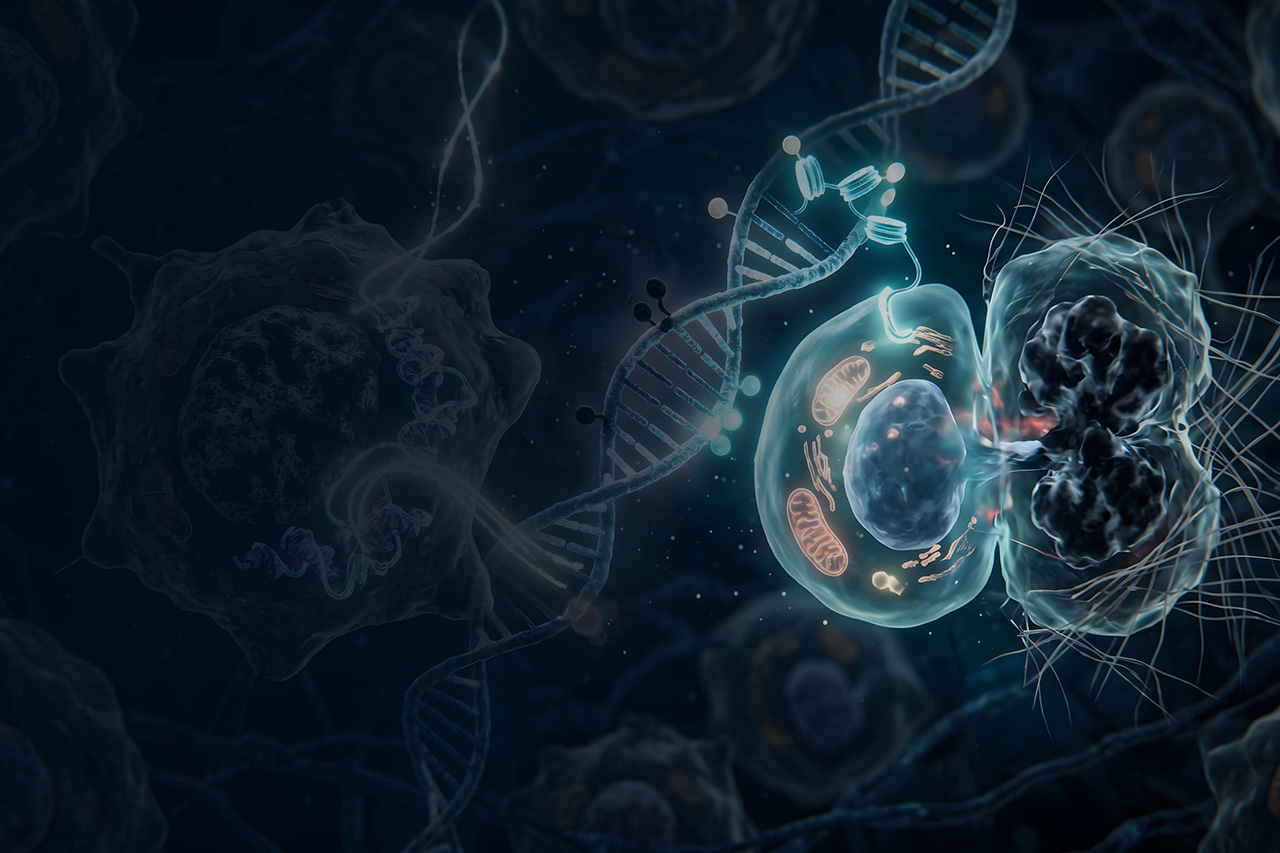
Given the close biological relationship between aging and cancer, it comes as no surprise that growing interest in the reversibility of aging-related biology has expanded into oncology research. This does not mean that cancer can simply be prevented through anti-aging therapies alone, nor that the complex biology of aging can yet be reliably reversed.
What it does suggest, however, is far more meaningful: some of the biological processes associated with aging may be modifiable. This matters because the biology of aging shapes both cancer development and the body’s ability to resist, respond to, and recover from disease.
Aging remains the single greatest risk factor for cancer. Over time, DNA damage accumulates, immune surveillance declines, chronic inflammation increases, and senescent cells begin to accumulate. Together, these changes create an environment in which cancer is more likely to develop, and more difficult for the body to suppress.
The relationship also works in reverse: cancer and oncology therapies can accelerate biological aging. Many survivors experience earlier frailty, impaired recovery capacity, and long-term complications associated with accelerated aging biology. Frailty, of example, occurs significantly more often in cancer survivors than in age-matched individuals without cancer.[1]
This makes aging biology relevant not only to prevention, but also to treatment response, recovery, and survivorship.
Why Aging Biology Matters in Oncology
If certain aspects of aging biology can be modified, then some cancer-related processes may also become more manageable. These include:
• Cellular senescence
• Chronic inflammation
• Mitochondrial dysfunction
• Declining DNA repair capacity
• Immune exhaustion
These are not simply hallmarks of aging, but also mechanisms that influence tumor progression, therapeutic response, and tissue recovery after treatment. In some emerging approaches, these same aging-associated mechanisms are being deliberately exploited against the cancer itself.
One area of active investigation is the “one-two punch” strategy, in which an initial therapy forces cancer cells into senescence, a state in which they stop dividing but remain biologically active. A second intervention then seeks to eliminate those cells before they can contribute to inflammation, tissue dysfunction, or tumor recurrence. This strategy is attracting interest because it attempts to separate the anti-tumor benefits of senescence from the chronic inflammation and broader tissue dysfunction senescent cells may later promote.
Rather than attempting to reverse aging, strategies like these are being explored as practical ways to improve treatment response, reduce long-term tissue damage, and support healthier recovery and survivorship after cancer therapy.[2]
Senescence is only one example of how aging-associated biology is increasingly shaping oncology research. Metabolic pathways linked to cellular repair, stress responses, and mitochondrial function have also attracted growing attention.
The NAD+ Conversation
Among these pathways, nicotinamide adenine dinucleotide (NAD+) has become one of the most widely discussed.
NAD+ is a critical coenzyme found in every living cell that plays a central role in DNA repair, mitochondrial function, and the regulation of enzymes such as sirtuins and PARPs. As NAD+ levels decline with age, cells become less efficient at repairing damage and maintaining metabolic balance.
This has made NAD+ restoration a major area of interest in aging research. There is growing evidence linking NAD+ decline to aging-related dysfunction, and early studies suggest that restoring NAD+ levels may support healthier cellular function. However, clinical evidence in humans remains limited, especially in oncology.
This distinction is important; there is currently no clinical evidence showing that NAD+ supplementation prevents cancer, despite how frequently such claims appear in the broader longevity market. In fact, the biology is inherently complex: pathways that support healthy cellular repair may also, under certain conditions, help damaged or pre-malignant cells survive and grow.[3][4]
This is one of the central challenges of geroscience in oncology: how do we repair aging-related damage without simultaneously helping cancer adapt?
Where LEUMUNA and MS 001 Fit
At the same time, the growing overlap between aging biology and oncology is also revealing how the same underlying pathways may be leveraged differently across distinct therapeutic settings.
LEUMUNA™ and MS 001 are development programs built around the same underlying purine nucleoside phosphorylase (PNP) inhibition platform, but are being developed toward fundamentally different therapeutic objectives. LEUMUNA is being developed by Helix BioPharma for the treatment of leukemia relapse following allogeneic stem cell transplantation, where preclinical studies have demonstrated significant survival benefits in mouse models of B-cell acute leukemia relapse.[5] MS 001, licensed by Helix to MetaShape Pharma, is being explored in obesity and potentially neurodegenerative disease, where preclinical findings have included fat-selective weight loss in obese mice and increased NAD+ expression in murine brain tissue.[6]
Together, these programs illustrate how pathways associated with immune regulation, metabolism, and aging biology may have relevance across multiple therapeutic areas, while still being directed toward highly context-specific therapeutic goals. In practice, the biological effects of PNP inhibition are shaped not only by the pathway itself, but also by factors such as disease setting, treatment combination, immune environment, and dosing strategy.
Partial Epigenetic Reprogramming
The expanding scientific interest in aging-associated biology has also contributed to growing attention around partial epigenetic reprogramming, an emerging field that has moved rapidly from academic research into mainstream public discourse and social media. Much of this attention has centered on the work of Harvard Professor and biotech founder David Sinclair, as well as other researchers exploring whether aspects of biological aging can be reset at the cellular level.[7]
The concept is based on the discovery that adult cells can be reprogrammed using a group of transcription factors known as the Yamanaka factors—genes capable of reprogramming adult cells back into an embryonic-like state.[8]
Whereas full cellular reprogramming can return mature cells to an embryonic-like stem-cell state, it also carries substantial risks, including loss of cell identity and tumor formation. Partial epigenetic reprogramming attempts something more controlled: rather than fully resetting cells, it aims to restore more youthful epigenetic patterns, improve cellular function, enhance tissue regeneration, and reverse certain aspects of cellular aging while preserving the cell’s original identity. In Sinclair’s work, this typically involves the use of three of the four Yamanaka factors (Oct4, Sox2, and Klf4), while excluding c-Myc, a factor strongly associated with oncogenic activity.[9]
Cancer is, in many ways, a disease of dysregulated cellular programming. Any strategy designed to increase cellular plasticity, regeneration, or survival must therefore confront an unavoidable question: can damaged cells be rejuvenated without also helping cancer to emerge or adapt?
The reality is that we do not yet know, and that this question sits at the center of some of the most ambitious research currently underway in aging biology and regenerative medicine.
At the same time, if partial epigenetic reprogramming can eventually be controlled safely, its implications could extend across some of oncology’s most difficult challenges. Future applications could theoretically include restoring tissue damaged by chemotherapy or radiation, improving immune recovery, reducing treatment-associated biological aging, or enhancing long-term survivorship after intensive cancer therapy. More speculatively, researchers are also exploring whether controlled epigenetic reprogramming could one day help restore differentiation, reverse malignant cellular states, or overcome treatment resistance in certain cancers.[10]
For now, these possibilities remain highly experimental, and the balance between regeneration and oncogenic risk remains one of the field’s central unresolved questions.
Still, the growing interest surrounding partial epigenetic reprogramming reflects something larger taking place across aging research and oncology alike: a shift away from viewing aging solely as an irreversible decline, and toward understanding whether some aspects of cellular function can be restored, redirected, or therapeutically controlled.
A More Practical View of “Reversible Aging”
The most important takeaway is not that aging can simply be reversed. It is that the biological processes associated with aging may increasingly become therapeutically controllable.
This possibility carries enormous implications for oncology. The same mechanisms that influence tissue degeneration, immune decline, and cellular dysfunction also shape how cancers emerge, evolve, respond to treatment, and recur. As aging biology becomes more programmable, oncology may gain entirely new ways to influence not only tumor behavior, but also the body’s ability to recover from the disease and therapy.
At the same time, the field remains defined by a profound tension: many of the processes associated with regeneration, cellular plasticity, and repair overlap with mechanisms that cancer itself exploits. The challenge, therefore, is not simply how to rejuvenate cells, but how to do so without destabilizing cellular identity or promoting malignant growth.
Whether through senescence-targeting strategies, metabolic interventions, or partial epigenetic reprogramming, the future of oncology may increasingly depend on learning how to control aging biology with precision, rather than simply attempting to reverse it.
Ref:
1. Sedrak MS, Cohen HJ. The Aging-Cancer Cycle: Mechanisms and Opportunities for Intervention. J Gerontol A Biol Sci Med Sci. 2023 Jul 8;78(7):1234-1238. doi: 10.1093/gerona/glac247. PMID: 36512079; PMCID: PMC10329223.
2. Sedrak MS, Cohen HJ. The Aging-Cancer Cycle: Mechanisms and Opportunities for Intervention. J Gerontol A Biol Sci Med Sci. 2023 Jul 8;78(7):1234-1238. doi: 10.1093/gerona/glac247. PMID: 36512079; PMCID: PMC10329223.
3. Conlon NJ. The Role of NAD+ in Regenerative Medicine. Plast Reconstr Surg. 2022 Oct 1;150(4 Suppl ):41S-48S. doi: 10.1097/PRS.0000000000009673. Epub 2021 Sep 28. PMID: 36170435; PMCID: PMC9512238.
4. Covarrubias AJ, Perrone R, Grozio A, Verdin E. NAD+ metabolism and its roles in cellular processes during ageing. Nat Rev Mol Cell Biol. 2021 Feb;22(2):119-141. doi: 10.1038/s41580-020-00313-x. Epub 2020 Dec 22. PMID: 33353981; PMCID: PMC7963035.
8. https://pubmed.ncbi.nlm.nih.gov/16904174/
9. https://pmc.ncbi.nlm.nih.gov/articles/PMC7752134/
10. https://pmc.ncbi.nlm.nih.gov/articles/PMC9974167/; https://www.nature.com/articles/s41392-025-02266-z