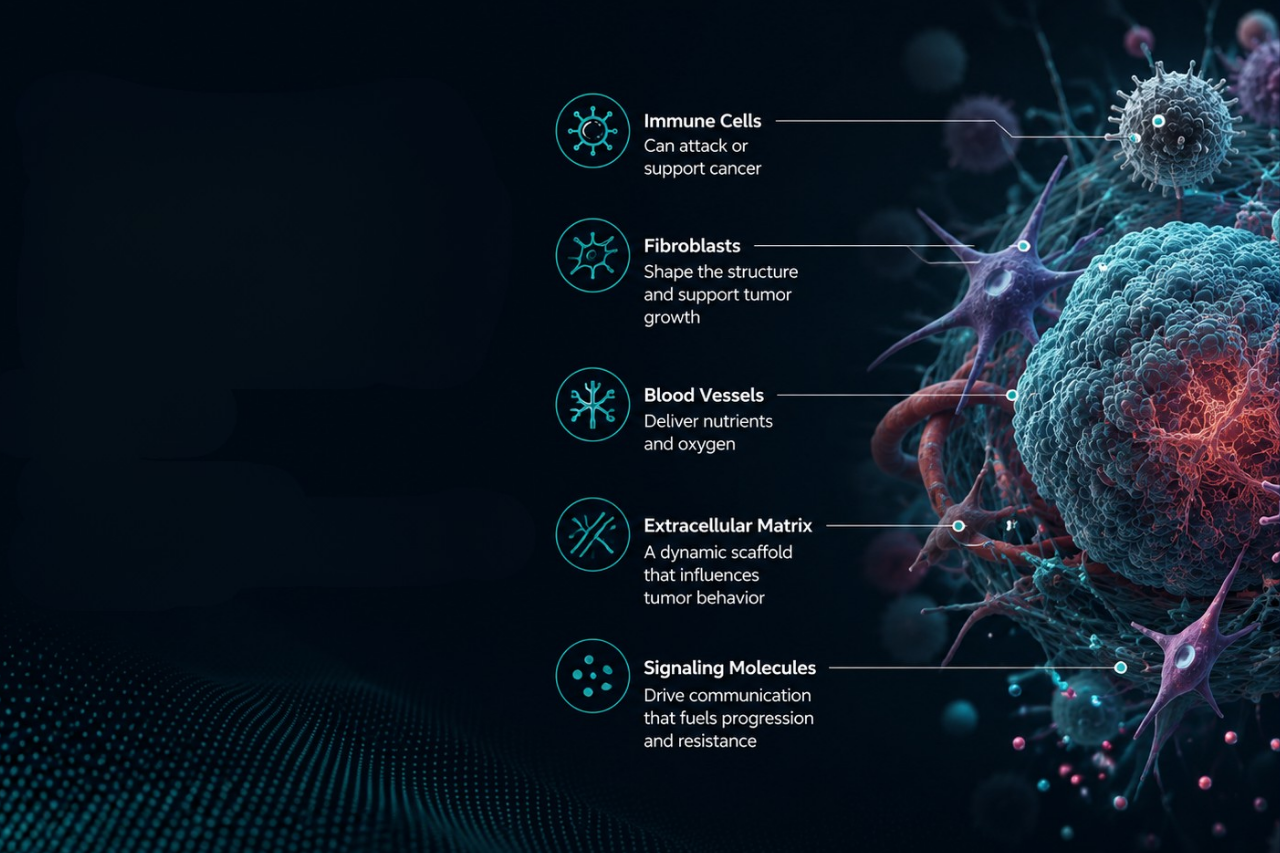
For decades, oncology focused on one central question: What genetic mutations are driving this tumor? That question revolutionized cancer treatment, giving rise to targeted therapies and precision medicine. But it also revealed an important limitation. A tumor is never just a collection of cancer cells. It exists within a living ecosystem that can determine whether a therapy succeeds, or fails.
Solid tumors exist within a complex tumor microenvironment (TME) made up of immune cells, stromal cells, blood vessels, extracellular matrix, and signaling molecules. These components constantly interact with one another, shaping how tumors grow, spread, and respond to treatment.[1]
This is creating a perspective shift within drug development. Instead of asking “Can this drug kill cancer cells?”, researchers are now asking “Can this drug still work inside the hostile ecosystem protecting those cancer cells?”
The TME is the neighborhood surrounding cancer cells. Rather than being passive support tissue, it actively influences disease progression.[2][3] Together with malignant cells are immune cells such as T cells, macrophages, dendritic cells, and neutrophils, which can either destroy cancer or become reprogrammed to support its growth. Fibroblasts produce structural proteins and signaling molecules that remodel tissue and promote survival. Endothelial cells regulate blood vessel formation, while adipocytes and other resident cells contribute metabolic support.[3]
As treatment applies selective pressure, the microenvironment adapts, sometimes becoming more immunosuppressive, more fibrotic, or more resistant to therapy.[3] This helps explain why two patients carrying the same mutation may respond very differently to identical treatment. The difference often lies not in the mutation itself, but in the environment surrounding it.
Why stromal cells matter
Among the many components shaping the TME, stromal cells have emerged as some of the most influential, particularly cancer-associated fibroblasts (CAFs).
CAFs produce growth factors, cytokines, and extracellular matrix proteins that promote invasion, metastasis, and immune evasion. They also increase tissue stiffness through excessive matrix deposition, creating a physical barrier that makes tumors harder to penetrate.
This has important implications for therapy development. Stromal biology is increasingly becoming a therapeutic target itself. Rather than eliminating fibroblasts indiscriminately, researchers are exploring strategies to selectively remodel stromal function and improve drug delivery while preserving normal tissue architecture.[4]
Hypoxia changes how tumors behave
The TME is shaped not only by the cells it contains, but also by its physical and metabolic conditions. One of the most important is oxygen availability. Many solid tumors grow faster than their blood supply can support, creating regions with very low oxygen levels, known as hypoxia. Hypoxia fundamentally changes tumor biology.
Under hypoxic conditions, cancer cells switch their metabolism, activate stress-response pathways, and select for clones capable of surviving hostile environments. At the same time, hypoxia suppresses anti-tumor immunity, promoting immunosuppressive macrophages, reducing T-cell activity, and increasing signals that encourage new blood vessel formation.
Clinically, this makes hypoxia an increasingly valuable biological marker. Patients with highly hypoxic tumors may benefit from combination strategies that pair standard treatment with vascular normalization, metabolic therapies, or hypoxia-targeted agents designed to overcome the tumor’s survival mechanisms.[3][5][6]
For drug developers, hypoxia represents more than a hallmark of aggressive disease; it is a source of therapeutic resistance that can influence trial outcomes, biomarker selection, and combination therapy design.
Why the extracellular matrix limits treatment
One of the greatest challenges in treating solid tumors is getting sufficient quantities of the drug to the cancer cells. The extracellular matrix (ECM) is more than structural scaffolding; when remodeled by tumors, it becomes a physical and biochemical barrier that limits drug penetration while supporting invasion and immune evasion. While essential for normal tissue function, excessive ECM remodeling creates a stiff, highly organized barrier that limits drug diffusion.
Combined with poor vascularization and elevated interstitial pressure, this produces protected regions where therapies struggle to penetrate – barriers that help explain why promising preclinical candidates sometimes underperform in the clinic despite potent activity against isolated cancer cells.
Tumors and the immune system exist in constant dialogue, exchanging signals that can either promote immune surveillance or suppress it. They release cytokines, chemokines, metabolites, and checkpoint molecules that influence immune behavior. In response, immune cells may either mount an anti-tumor attack or become reprogrammed into suppressive populations that protect the cancer.
This ongoing dialogue explains why immunotherapy succeeds in some patients but fails in others: the TME prevents immune cells from functioning effectively, even when immune recognition has already occurred.
Understanding these communication networks is opening new therapeutic opportunities, including checkpoint inhibitors, macrophage reprogramming, stromal targeting, and immune-modulating combination therapies designed to restore effective anti-tumor immunity.[7-10]
Seeing the tumor in context
The growing understanding of the TME is transforming oncology drug development. Rather than designing therapies that exclusively target tumor cells, researchers are increasingly developing treatments that also modify the environment protecting those cells.
This includes:
• Remodeling the extracellular matrix to improve drug penetration.
• Normalizing abnormal blood vessels to enhance delivery.
• Targeting hypoxia-driven biology.
• Reprogramming stromal and immune cells.
• Developing rational combination therapies that first reshape the microenvironment before delivering cytotoxic or immune-based treatment.
In many cases, one therapy prepares the ecosystem, allowing another to work more effectively.
Two patients with identical genetic alterations may require different treatment strategies if one tumor is immune-inflamed and well perfused while the other is hypoxic, matrix-rich, and immune-excluded. This is why the tumor microenvironment is becoming an important layer of precision oncology. Patient selection is increasingly incorporating biological features beyond DNA mutations alone, helping clinicians choose therapies that match both the tumor’s genetics and the environment in which those genetics operate.[7, 11-14]
Advances in spatial transcriptomics and multiplex imaging are also allowing researchers to visualize where different cell populations are located within tumors, not simply which cells are present. These technologies reveal how immune cells, stromal cells, and cancer cells interact in space, offering new biomarkers and helping explain why some therapies succeed only in specific regions of a tumor. As these tools mature, spatial biology is expected to become an increasingly important component of precision oncology.
Looking ahead
The traditional view of cancer focused on malignant cells as isolated targets. Modern oncology recognizes that these cells survive because they are supported by an adaptive ecosystem that evolves throughout the course of disease.
Future therapies will increasingly aim to disrupt this ecosystem as much as the cancer itself.
Success will depend not only on identifying the right molecular target but also on ensuring therapies can penetrate the tumor, overcome immune suppression, remodel the surrounding tissue, and remain effective within a constantly changing microenvironment.
At Helix BioPharma, we believe the next generation of oncology therapies will be defined not only by what they target, but by the environments in which they must operate. By integrating tumor biology with the biology of the TME. we aim to develop smarter therapeutic strategies, improve patient selection, and design combination approaches that both address cancer cells and the ecosystem that enables their survival.
Bibliography
1. National cancer institute (.Gov). Cancer.gov. February 2, 2011. Accessed July 19, 2026. https://www.cancer.gov/publications/dictionaries/cancer-terms/def/tumor-microenvironment
2. Anderson NM, Simon MC. The tumor microenvironment. Curr Biol. 2020;30(16):R921-R925. doi:10.1016/j.cub.2020.06.081
3. Roy S, Kumaravel S, Sharma A, Duran CL, Bayless KJ, Chakraborty S. Hypoxic tumor microenvironment: Implications for cancer therapy. Exp Biol Med (Maywood). 2020;245(13):1073-1086. doi:10.1177/1535370220934038
4. da Cunha BR, Domingos C, Stefanini ACB, et al. Cellular interactions in the tumor microenvironment: The role of secretome. J Cancer. 2019;10(19):4574-4587. doi:10.7150/jca.21780
5. Hompland T, Fjeldbo CS, Lyng H. Tumor hypoxia as a barrier in cancer therapy: Why levels matter. Cancers (Basel). 2021;13(3):499. doi:10.3390/cancers13030499
6. Jing X, Yang F, Shao C, et al. Role of hypoxia in cancer therapy by regulating the tumor microenvironment. Mol Cancer. 2019;18(1):157. doi:10.1186/s12943-019-1089-9
7. Xu X, Wu Y, Qian X, et al. Nanomedicine strategies to circumvent intratumor extracellular matrix barriers for cancer therapy. Adv Healthc Mater. 2022;11(1):e2101428. doi:10.1002/adhm.202101428
8. Subrahmanyam N, Ghandehari H. Harnessing extracellular matrix biology for tumor drug delivery. J Pers Med. 2021;11(2):88. doi:10.3390/jpm11020088
9. Huang J, Zhang L, Wan D, et al. Extracellular matrix and its therapeutic potential for cancer treatment. Signal Transduct Target Ther. 2021;6(1):153. doi:10.1038/s41392-021-00544-0
10. Desai N, Sahel D, Kubal B, et al. Role of the extracellular matrix in cancer: Insights into tumor progression and therapy. Adv Ther (Weinh). 2025;8(2). doi:10.1002/adtp.202400370
11. Schiavoni G, Gabriele L, Mattei F. The tumor microenvironment: a pitch for multiple players. Front Oncol. 2013;3:90. doi:10.3389/fonc.2013.00090
12. Farc O, Cristea V. An overview of the tumor microenvironment, from cells to complex networks (Review). Exp Ther Med. 2021;21(1):96. doi:10.3892/etm.2020.9528