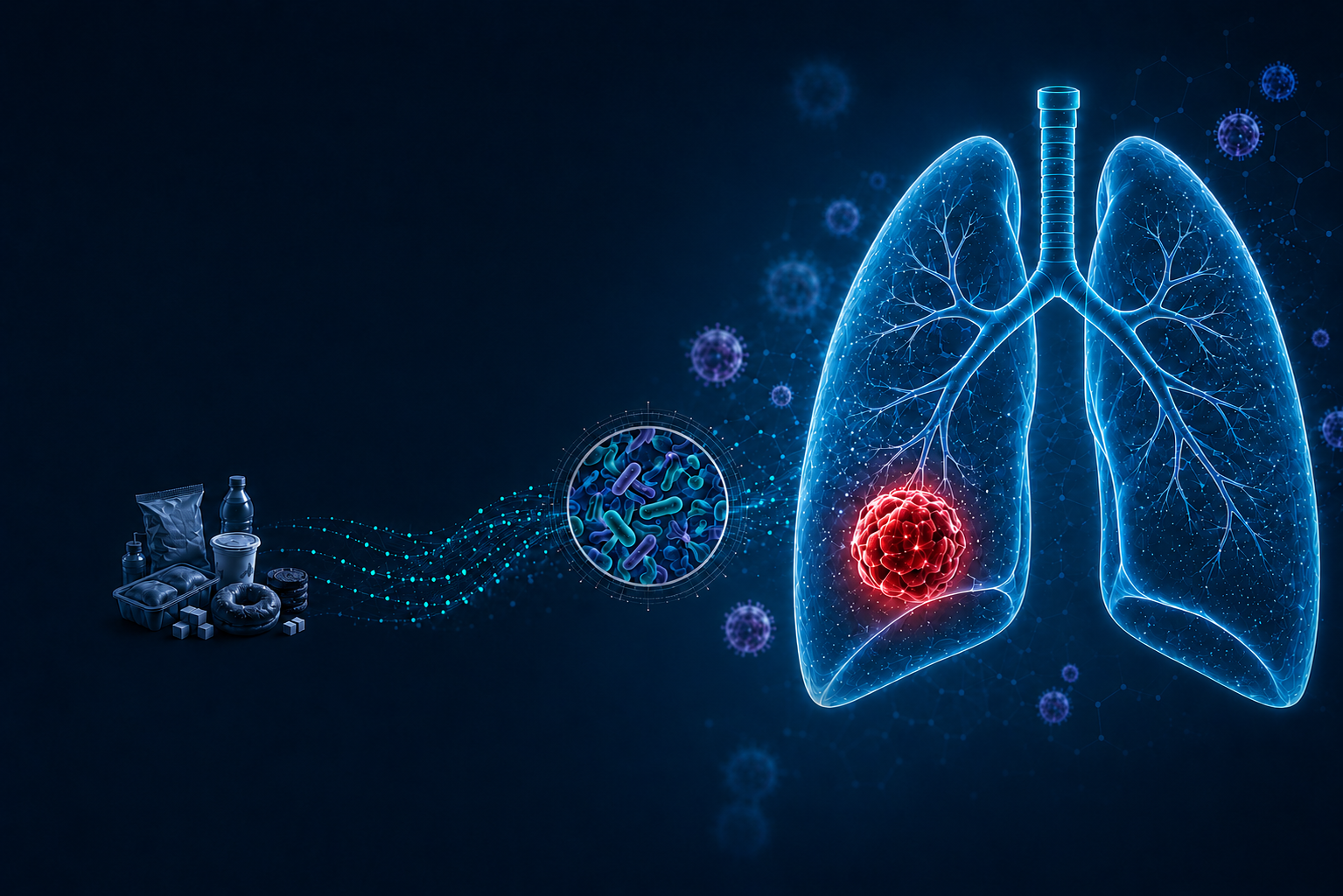
Ultra-Processed Foods, the Microbiome, and Lung Cancer: An Unexpected Connection

Ultra-processed foods are usually discussed in the context of obesity, diabetes, cardiovascular disease, and colorectal cancer. But emerging research is beginning to raise a more unexpected question: could these foods also be linked to lung cancer?

The answer is not yet definitive. Smoking remains the dominant risk factor for lung cancer, and observational nutrition studies cannot prove causation on their own. However, recent data suggests that diet quality, inflammation, immune regulation, and the gut microbiome may all contribute to the biological environment in which cancer develops — even in organs not directly linked to digestion.

What are Ultra-Processed Foods (UPFs)?

Ultra-processed foods (UPFs) are industrially-manufactured products made largely from refined ingredients, additives, preservatives, emulsifiers, flavor enhancers, and other substances not typically used in home cooking. Common examples include packaged snacks, soft drinks, instant noodles, processed meats, sweetened breakfast cereals, and many ready-to-eat meals.

These products are often high in added sugar, salt, and unhealthy fats, while being low in fiber, micronutrients and naturally occurring bioactive compounds. High UPF consumption has already been associated with increased risk of several chronic diseases and some cancers, particularly colorectal and hormone-related cancers. More recently, researchers have begun exploring whether UPFs may also be associated with lung cancer risk.[1]

How UPFs May Disrupt the Gut Microbiome

The gut microbiome is a complex ecosystem of trillions of microorganisms that helps regulate digestion, metabolism, immune function, and inflammation.

Diets rich in whole plant foods tend to support microbial diversity and the production of beneficial metabolites, including short-chain fatty acids such as butyrate, acetate, and propionate. These compounds help maintain the gut barrier, regulate immune responses, and limit excessive inflammation.

Ultra-processed diets may shift this balance in the opposite direction. They are often low in fiber, which deprives beneficial microbes from the substrates they need to produce short-chain fatty acids. At the same time, certain additives commonly found in UPFs, including emulsifiers and artificial sweeteners, have been studied for their potential to alter microbial composition and gut barrier function.

When the gut barrier becomes more permeable, bacterial components such as lipopolysaccharides can pass into circulation, contributing to chronic, low-grade inflammation. This kind of sustained inflammatory state is increasingly recognized as one of the conditions that can support cancer initiation and progression. [1][2]

From Gut Imbalance to Cancer-Permissive Inflammation

The connection between diet, the microbiome, and cancer is not based on one single pathway. It is likely to involve several overlapping mechanisms.

When inflammation becomes systemic, inflammatory mediators such as IL-6 and TNF-α can influence DNA damage, cellular stress responses, angiogenesis, immune escape, and tissue remodeling. These are all processes that can contribute to a more cancer-permissive environment.

UPFs may also introduce or increase exposure to compounds formed during processing, food packaging, or high-temperature preparation. These include substances such as acrylamide, acrolein, bisphenols, phthalates, and other contaminants or additives that are being investigated for their potential biological impacts. Scientists are still working to understand how much these compounds matter, but they may be one more reason UPFs are drawing attention in cancer research.

The key point is that high UPF intake may contribute to a biological state marked by poorer diet quality, microbial disruption, metabolic stress, and inflammation — all of which are relevant to cancer biology.[1]

The Gut–Lung Axis: Why the Gut May Matter for Lung Health

One of the most important developments in microbiome science is the concept of the gut–lung axis.

This refers to the communication between the gut and lungs through immune, metabolic, and inflammatory pathways. Microbial metabolites produced in the gut can circulate throughout the body and influence immune responses in distant organs, including the lungs.

In lung cancer, researchers have observed that the gut and airway microbiomes may differ between people with cancer and those without it. Microbiome composition has also been linked to differences in response to immune checkpoint inhibitors and chemo-immunotherapy in non-small cell lung cancer (NSCLC).[3] In one recent study, responders to chemo-immunotherapy had higher microbial richness and greater abundance of specific short-chain-fatty-acid (SCFA)-producing bacteria. In mouse models, fecal microbiota transplantation and SCFA supplementation enhanced treatment efficacy by promoting effector T-cell activity in tumors.[4]

This does not mean that microbiome modulation is ready to replace established cancer prevention or treatment strategies. But it does reinforce an important idea: the immune environment that shapes cancer is not confined to the tumor alone.

Emerging Evidence Linking UPFs to Lung Cancer

A recent population-based cohort study examined data from over 100,000 adults in the U.S. Prostate, Lung, Colorectal and Ovarian Cancer Screening Trial. Participants were followed for an average of 12 years, during which 1,706 new lung cancer cases were diagnosed.[5]

The study found that people with the highest quartile of UPF consumption had a 41% higher risk of lung cancer compared with those in the lowest quartile. The association was reported for both non-small cell lung cancer and small cell lung cancer.[6]

While these findings are important, they need to be interpreted with caution: the study was observational, meaning it can identify associations but cannot prove cause and effect.

Nonetheless, the study is important because it brings epidemiological evidence into alignment with a growing biological rationale: ultra-processed diets may disrupt the gut microbiome, amplify systemic inflammation, and alter immune signaling across the gut-lung axis, creating conditions that could influence lung cancer risk.

A Broader View on Cancer Prevention

The potential link between UPFs, the gut microbiome, and lung cancer reflects a broader shift in oncology.

Cancer risk is no longer understood only through isolated factors such as smoking, genetics, or environmental exposure — though these remain critically important. But cancer biology is also shaped by metabolism, immunity, chronic inflammation, tissue environment, and the microbiome.

For individuals and public health systems, the practical message is quite clear: reducing reliance on UPFs and increasing intake of whole, minimally processed foods (including vegetables, fruits, whole grains, nuts, seeds, and fiber-rich foods) may help support microbial diversity, reduce inflammatory burden, and improve overall health.

More research is needed to clarify to what extent UPFs play a direct role in lung cancer development, and through which mechanisms. But the emerging evidence points to an important principle: what we eat influences far more than digestion. It helps shape the microbial, immune and inflammatory landscape in which disease risk evolves — and nutrition is one part of that landscape we can directly influence.


Ref:

1. Lian Y, Wang GP, Chen GQ, Chen HN, Zhang GY. Association between ultra-processed foods and risk of cancer: a systematic review and meta-analysis. Front Nutr . 2023;10:1175994. Published 2023 Jun 8. doi:10.3389/fnut.2023.1175994

2. How ultra-processed foods harm your gut microbiome. Citizens Specialty Hospital. Accessed March 26, 2026. https://www.citizenshospitals.com/blogs/how-ultra-processed-foods-harm-your-gut-microbiome

3. Liu J, Hong W, Sun Z, Zhang S, Xue C, Dong N. The gut-lung axis: effects and mechanisms of gut microbiota on pulmonary diseases. Front Immunol . 2026;16:1693964. Published 2026 Jan 5. doi:10.3389/fimmu.2025.1693964

4. Yang Y, Ye M, Song Y, et al. Gut microbiota and SCFAs improve the treatment efficacy of chemotherapy and immunotherapy in NSCLC. NPJ Biofilms Microbiomes . 2025;11(1):146. doi:10.1038/s41522-025-00785-9

5. Ahmed H. Higher ultra processed food intake linked to increased lung cancer risk – BMJ Group. BMJ Group – Helping doctors make better decisions. July 30, 2025. Accessed May 27, 2026. https://bmjgroup.com/higher-ultra-processed-food-intake-linked-to-increased-lung-cancer-risk/

6. Expert reaction to study looking at ultra-processed food consumption and lung cancer risk. Sciencemediacentre.org. Accessed May 27, 2026. https://www.sciencemediacentre.org/expert-reaction-to-study-looking-at-ultra-processed-food-consumption-and-lung-cancer-risk/

Jacek Antas

Chief Executive Officer


Jacek Antas is a shareholder of the Company, has spent more than 25 years in the financial services industry holding various positions in sales and consulting.

Mr. Antas obtained a master’s degree from the Warsaw School of Economics and has served as a board member of various
companies throughout his career.

This will close in 0 seconds

James B. Murphy

Chief Financial Officer


Mr. Murphy is a certified public accountant with over thirty years of experience in finance and operations management. He is currently a consultant with Danforth Advisors LLC (“Danforth”), a leading provider of outsourced strategic and operational specialists across functions in the life sciences industry. While at Danforth, Mr. Murphy has served over fifteen private and publicly held life sciences companies as CFO and CFO Advisor, helping them secure over USD 0.5 billion in financing and successfully execute pivotal asset transactions. Mr. Murphy functions as a consultant to Helix pursuant to a consulting agreement between the Company and Danforth.

This will close in 0 seconds

Thomas Mehrling

Medical Adviser


Thomas Mehrling (PhD in Pharmacology and MD) has over 20 years’ experience in multinational Pharma companies developing novel oncology compounds from preclinical research through to registration. Prior to entering the industry, he spent 13 years as an MD at the University Hospital in Frankfurt, working on preclinical and translational projects. He served as Director of European Oncology at Mundipharma International (2003–2013), building the company’s first European oncology business from the ground up out of Cambridge, UK, and completing the clinical development, registration and launch of two major products in Europe, DepoCyte® and Levact® (Ribomustin® and Treanda®). In 2013, he led the establishment of the Mundipharma Group’s start-up, Mundipharma EDO, developing anti-cancer therapeutics for solid tumours out of Basel, Switzerland.

This will close in 0 seconds

Kim Gaspar

Director Quality Assurance


Kim is the Director of Quality Assurance at Helix BioPharma Corp. An experienced quality assurance professional with expertise in Canadian, US, and EU regulations, she has been involved in all aspects of Phase I/II biopharmaceutical product development over the years, including regulatory submissions, QC laboratory compliance, tech transfer and third-party oversight of CMC activities, clinical QA, and bioanalytical data analysis. Kim joined Helix in 2000, transitioning into QA in 2003. She holds a B.Sc in Biochemistry and a Ph.D in Veterinary Physiological Sciences, both from the University of Saskatchewan.

This will close in 0 seconds

Brenda Lee

Director Clinical Operations


Brenda is the Clinical Operations Director at Helix Biopharma Corp. A clinical research operations professional with 25 years of experience managing clinical trials, ranging from early Phase I to late Phase IIIb/IV studies, she brings experience in clinical study protocol writing and development, trial start-up and vendor management, and a proven track record in planning and managing clinical trials to quality standards, timelines and budget. Brenda joined Helix Biopharma Corp. in 2018, working to advance the clinical program of L-DOS47. She holds B.Sc and M.Sc. degrees from the University of Toronto, specializing in Nutritional Sciences and Human Biology.

This will close in 0 seconds

Jerzy Leszczynski

Director


Jerzy Leszczynski is a shareholder of the Company, has spent more than 35 years developing businesses and has served in the capacity of board member of various real estate development companies. Mr. Leszczynski obtained his Master of Science in Chemistry from the Warsaw Institute of Technology.

This will close in 0 seconds

Janusz Grabski

Director, Chair of Audit Committee


Janusz (John) Grabski is a lawyer specialized in corporate and real estate law with over twenty years of experience.

This will close in 0 seconds

Malgorzata Laube

Director


Malgorzata Laube has over 19 years of experience in nuclear medicine. In her last role with Alberta Health Services, she was the Department Supervisor, Nuclear Medicine at Royal Alexandra Hospital. Ms. Laube obtained a MSc degree in Environmental Engineering from the Warsaw University of Technology and is based in Edmonton, Alberta, Canada.

This will close in 0 seconds

Jacek Antas

Chairman of the Board


Jacek Antas is a shareholder of the Company, has spent more than 25 years in the financial services industry holding various positions in sales and consulting.

Mr. Antas obtained a master’s degree from the Warsaw School of Economics and has served as a board member of various
companies throughout his career.

This will close in 0 seconds

Jonathan Davis

Advisor, ADC Discovery


Jonathan Davis received his Ph.D. from University of California, San Francisco, where he studied protein structure and function using NMR. After a post-doc at Harvard Medical School exploring RNA selection and structure in the labs of Jack Szostak and Gerhard Wagner, he went to work at EMD Serono, where his work involved improving antibody-based therapeutics, inventing a platform technology for generating heterodimeric Fcs as a basis for multifunctional molecules, and developing a novel scaffold based on an artificially-designed protein from David Baker’s lab. In 2008 he took a job at Bristol-Myers Squibb in Waltham/Cambridge MA, working on antibody discovery and platform development in a wide range of therapeutic areas, with a particular focus on multispecific therapeutics. He moved to Madison, WI in 2019 to take on the role of VP of Innovation and Strategy at Invenra, a biotech focused on bispecific antibodies, and where he is currently head of the Scientific Advisory Board. In early 2024 he left the corporate world to found Creative Antibodies, a consulting firm that helps guide companies to successful antibody discovery and development projects, from mAbs to multispecifics, ADCs, and other formats. Outside of science, Jonathan is a conservatory trained cellist, plays numerous other instruments, and founded the UCSF Orchestra (now Symphony Parnassus) in San Francisco, where he was Music Director for six years.

This will close in 0 seconds

Davide Guggi

Advisor, CMC


Davide graduated as a pharmacist and received his PhD in Pharmaceutical Technology and Biotechnology from the University of Vienna. He has over 20 years of experience in the pharmaceutical industry, principally in the field of oncology. At the beginning of his career, Davide led oncology business units and commercial departments at Mundipharma and Gilead across Austria and Eastern Europe. Since over 10 years he has been working as a CMC expert, covering operational and regulatory CMC functions on behalf of over 20 different small- and medium-sized biotech companies across the world. He has served as CMC Director and CSO/CTO for several years, developing both small molecules and biologics (mABs, Fab, ADCs and Radio-immuno-conjugates) from early discovery to NDA/BLA in the US, EU and Canada, with a focus on First-in-Human and Phase I/II studies in oncology indications.

This will close in 0 seconds

This will close in 0 seconds

Tumor Defense Breaker™, L-DOS47


L‑DOS47 is a first‑in‑class, clinical-stage antibody‑enzyme conjugate designed to deliver a game-changing assist to anti-cancer immunity and today’s leading cancer immunotherapies for the treatment of prevalent, hard-to-treat solid tumors. The compound precisely targets CEACAM6, a cell-surface protein overexpressed in non‑small cell lung cancer (NSCLC) and other aggressive tumors, where it delivers an enzymatic payload that raises the extracellular pH of the acidic tumor microenvironment (TME). By neutralizing tumor acidity, L-DOS47 restores immune cell infiltration and activity, helps turn immunologically “cold” tumors “hot”, and enhances the therapeutic reach of immune checkpoint inhibitors. With patented composition-of-matter coverage through 2036 and demonstrated synergy with PD-1 inhibitor, pembrolizumab, L-DOS47 is poised to significantly increase the efficacy of immune checkpoint blockade and unlock broader and more durable responses in NSCLC and other aggressive solid tumors.

This will close in 0 seconds

LEUMUNA™


LEUMUNA™ is an oral immune checkpoint modulator designed to activate the donor immune system to recognize and fight relapsing leukemia in patients who have undergone allogeneic stem cell transplantation (allo-SCT). Although a life-saving procedure, up to 30% of patients who undergo allo-SCT see their cancer return, facing a median survival of just four months. LEUMUNA aims to offer these patients a new lease on life, by activating an immune cascade and inciting graft-versus-leukemia (GvL) effect, potentially offering long-term remission. Backed by strong preclinical data and a promising safety record from trials with its precursor compound, ulodesine, LEUMUNA offers a patient‑friendly, oral approach to a difficult-to-treat condition, with patent protection through 2041 and an Orphan Drug Designation granted by the US FDA.

This will close in 0 seconds

GEMCEDA™


GEMCEDA is a first-in-class oral prodrug of gemcitabine that opens up the possibility for convenient at-home administration, metronomic dosing and seamless integration into combination regimens with immune checkpoint inhibitors. To date, gemcitabine is only administered intravenously because oral forms have shown poor bioavailability of about 10%. GEMCEDA was developed as a prodrug to enable new uses of gemcitabine by combining it with cedazuridine, an enzyme inhibitor that helps boost its bioavailability to 90%. This remarkable innovation allows for greater flexibility in dosing schedules, fewer clinic visits, and a better quality of life, while achieving bioavailability on par with intravenous gemcitabine. Supported by a well‑established safety profile, scalable manufacturing, and patent coverage to 2043, GEMCEDA reimagines how chemotherapy can fit into patients’ lives.

This will close in 0 seconds